Cash flow problems rarely begin on the day a business runs short of money. They usually start weeks earlier, when receivables slow down, inventory grows, a customer delays payment, an unexpected expense arrives, or a company takes on new work without planning for the cash needed to deliver it.
That risk deserves extra attention in 2026. Recent regional reports from the Federal Reserve have described tighter underwriting conditions that can affect small businesses, while other districts have noted slow payments and pockets of rising delinquency. At the same time, regulators continue to focus on payment fraud and suspicious transactions. The message for owners is simple: reliable cash management cannot depend on easy credit being available exactly when you need it.
This guide shows how to build a practical cash-flow system before a problem becomes urgent. It covers forecasting, receivables, inventory, payment controls, lender readiness, and real-world decisions that can improve resilience without turning the business into a finance department.
Start with the right question: when does cash actually move?
Profit and cash are connected, but they are not the same thing. A company can show a profit on its income statement and still struggle to pay payroll because customers have not paid yet.
Consider a small commercial contractor that completes $180,000 of work in September. The job is profitable, but the customer pays 60 days later. During those 60 days, the contractor must still cover wages, fuel, insurance, equipment rentals, materials, and taxes. The business may look healthy on paper while its bank balance falls.
Cash-flow management starts by mapping the timing of money, not just the amount.
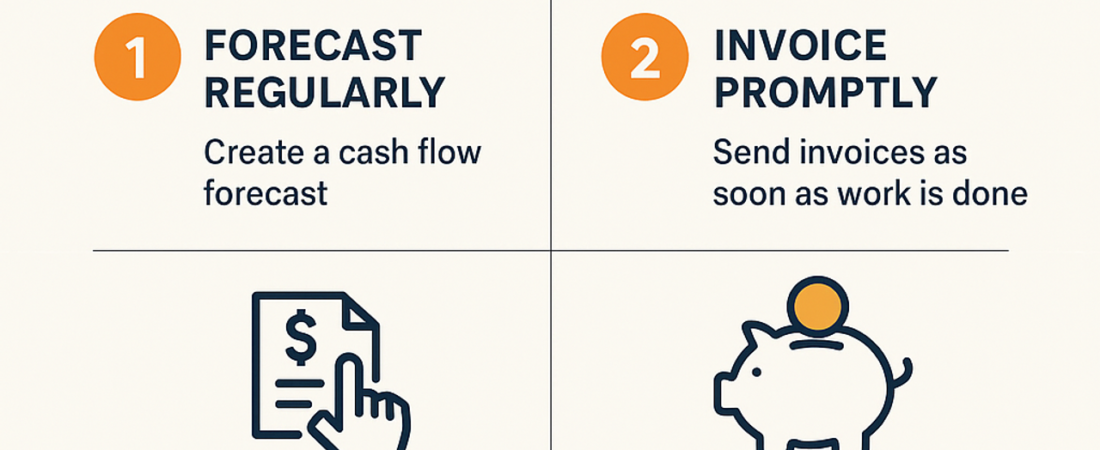
Build a 13-week cash-flow forecast
A 13-week forecast is one of the most useful tools for a small business because it is detailed enough for weekly decisions but short enough to remain realistic. It helps answer three questions:
- How much cash should be available each week?
- When is the lowest expected cash point?
- What decision must be made before that low point arrives?
Step 1: start with available cash
Use the actual bank balance available for operations. Exclude restricted funds or money already committed to taxes, payroll, debt payments, or another specific purpose.
Step 2: list expected cash inflows by week
Do not enter sales when invoices are issued. Enter the cash when you realistically expect to receive it. Use customer payment history rather than perfect assumptions.
If Customer A normally pays 15 days late, model that behavior until there is evidence it has changed. A forecast is a decision tool, not a sales target.
Step 3: list every major outflow
Include payroll, rent, software, insurance, supplier payments, loan payments, taxes, inventory, contractor costs, advertising, owner draws, and one-time expenses.
Step 4: calculate the weekly ending balance
The goal is to see pressure early. If the forecast shows a cash shortage in week eight, you have seven weeks to improve collections, reduce spending, adjust purchase timing, negotiate terms, or arrange financing.
Use three forecast cases, not one
A single forecast can create false confidence. Build a base case, a downside case, and an upside case.
Base case
Use normal sales, normal collection times, and expected expenses.
Downside case
Delay major receivables, reduce new sales, add a realistic cost increase, and assume one unexpected expense. The purpose is not to predict disaster. It is to test whether the company can stay operational if conditions become less favorable.
Upside case
Higher sales can also create a cash problem. Add the extra inventory, labor, shipping, commissions, fulfillment costs, and receivables that growth requires. A fast-growing company can run out of cash because it must spend before customers pay.
Measure the cash conversion cycle
The cash conversion cycle shows how long money is tied up between paying for goods or services and collecting cash from customers. For many small businesses, reducing this gap is more useful than cutting small expenses.
Look at three areas
- Receivable days: how long customers take to pay.
- Inventory days: how long products sit before sale.
- Payable days: how long the business has to pay suppliers.
A company does not need a complex financial model to improve these numbers. It can invoice faster, request deposits, stop over-ordering slow products, and negotiate better supplier terms.
Fix receivables before looking for more debt
Many cash-flow gaps begin in accounts receivable. If customers owe the company $300,000 and average payment time rises from 35 to 55 days, the business may suddenly need outside financing to replace cash that should already have arrived.
Invoice immediately
Do not wait until the end of the week or month if the work is complete. A five-day delay in invoicing often becomes a five-day delay in payment.
Make invoices easy to approve
Include the correct purchase order, project code, contact name, tax information, payment instructions, and supporting documentation. Many “late payments” are actually invoices stuck in an approval process because information is missing.
Use deposits and milestone billing
For project-based work, consider whether a deposit or milestone schedule is appropriate. A design firm, for example, might collect part of the fee at project start, another portion after a defined milestone, and the balance at final delivery.
Follow up before an invoice is overdue
A short confirmation a few days before the due date can reveal problems early. Ask whether the invoice has been approved, whether any documents are missing, and whether payment is scheduled.
Segment customers by payment risk
Not every customer deserves the same credit terms. A long-term customer with a strong payment record is different from a new buyer placing a large first order.
Create a simple risk system:
- Low risk: consistent payment history and manageable order size.
- Medium risk: occasional delays, rapid order growth, or limited history.
- High risk: repeated late payment, disputed invoices, weak communication, or unusually large exposure.
For higher-risk accounts, consider smaller credit limits, deposits, shorter terms, staged delivery, or payment before shipment. The goal is not to punish customers. It is to prevent one account from creating a company-wide cash problem.
Control payment fraud without slowing the business
Payment fraud can create a sudden cash loss, especially when staff rely on email instructions for bank-account changes or urgent transfers. Federal banking regulators have continued to emphasize fraud-related information sharing and suspicious activity in 2026. The Federal Reserve’s fraud-related guidance is aimed at financial institutions, but the broader lesson is relevant to businesses: payment controls and verification matter.
Use a two-person approval rule for sensitive payments
Large wires, new payees, bank-detail changes, and unusual refunds should require a second review.
Verify bank-detail changes outside email
If a supplier emails new bank instructions, call a known contact using a previously verified number. Do not use a phone number included in the change request itself.
Limit user permissions
The employee who enters a new vendor should not always be the same person who approves the payment. Separation of duties reduces both error and fraud risk.
Reconcile accounts frequently
Weekly or even daily review of high-volume accounts can identify unusual transactions faster than a month-end process.
Manage inventory as cash, not just stock
Inventory sitting on a shelf is cash that cannot pay payroll. Businesses often over-order because they fear stockouts, chase volume discounts, or use last year’s sales without adjusting for current demand.
Split inventory into fast-moving, steady, slow-moving, and obsolete groups. Then create different purchasing rules for each.
Example: a specialty retailer
A retailer has $220,000 of inventory. Analysis shows that $48,000 has not sold in nine months. Instead of ordering more of every product, the owner stops reordering the slow items, creates a controlled clearance plan, and redirects purchasing toward high-turn products. That does more for cash flow than canceling a few small subscriptions.
Build a minimum cash reserve policy
“Keep some cash in the bank” is too vague. Define a minimum operating balance based on real obligations.
A simple starting point is to calculate essential monthly outflows such as payroll, rent, insurance, debt service, utilities, and critical supplier payments. Then decide how many weeks or months of those costs the company wants available.
The right reserve depends on the business. A subscription company with predictable monthly collections may need a different buffer than a construction company with large project-based receivables.
Know when to use a line of credit
A line of credit can be useful for temporary working-capital needs, but it should not become permanent financing for structural losses.
A healthy use
A wholesaler buys seasonal inventory in August, sells it during the holiday period, collects customer payments, and repays the line in January.
A warning sign
A company uses the line every month to cover payroll because normal operations do not generate enough cash. The balance never falls. In that case, more borrowing may delay the underlying problem instead of solving it.
Track whether borrowed working capital actually converts back to cash. If it does not, revisit pricing, gross margin, staffing, inventory, and receivables.
Prepare for credit before you urgently need it
Tighter lending standards are most painful when a business waits until cash is already low. Lenders prefer to review a company that is organized and still has options.
Keep the following ready:
- Current profit and loss statement
- Current balance sheet
- 13-week cash-flow forecast
- Accounts receivable aging
- Accounts payable aging
- Debt schedule
- Recent tax returns
- Bank statements
- Explanation of any unusual losses or one-time expenses
When these records are current, financing conversations move faster and management also makes better internal decisions.
Protect gross margin before cutting growth
Cash problems often lead owners to cut marketing, training, technology, or maintenance first because those expenses are easy to see. That may help temporarily but can weaken the business if the real problem is pricing or margin.
Review margin by customer, product, and service
A $50,000 customer is not automatically more valuable than a $20,000 customer. The larger account may require more support, longer payment terms, free delivery, custom work, and repeated rework.
Calculate contribution after the direct costs needed to serve the account. Raise prices, change scope, or renegotiate terms where the economics no longer work.
A weekly cash meeting that takes 20 minutes
Small companies do not need a long finance meeting. A short weekly review can be enough if it focuses on decisions.
- Opening bank balance
- Cash expected in the next two weeks
- Largest overdue invoices
- Major payments due
- Inventory purchases that can be delayed or reduced
- Any unusual payment or fraud risk
- Expected lowest cash point in the 13-week forecast
- One action owner for each issue
Keep the meeting factual. The goal is to decide who will call a customer, approve a purchase, negotiate a supplier term, update the forecast, or contact a lender.
Real-world scenario: profitable growth creates a cash squeeze
A small B2B services company wins three new contracts worth $600,000 per year. The work is profitable, but the company must hire six employees immediately. Customers pay 45 days after invoicing, while payroll is due every two weeks.
The owner initially sees the contracts as a pure growth win. A 13-week forecast shows a different picture: cash falls sharply before the first large invoices are collected.
The company responds by negotiating a startup payment with one customer, delaying two nonessential equipment purchases, arranging a modest working-capital facility before cash becomes tight, and staging hiring over four weeks. The contracts remain profitable, but the financing plan now matches the timing of the growth.
30-day cash-flow improvement plan
Days 1-7: create visibility
Build the 13-week forecast, update receivable and payable aging, and identify the lowest expected cash week.
Days 8-14: improve collections
Contact overdue accounts, fix invoice errors, confirm approval status, and apply deposits or milestone billing where appropriate.
Days 15-21: release trapped cash
Review slow inventory, unnecessary prepayments, low-margin work, and purchases that can be rescheduled.
Days 22-30: strengthen resilience
Set a minimum cash reserve, review payment controls, update lender-ready financial documents, and decide what financing options should be available before they are needed.
Final takeaway
Strong cash flow in 2026 depends on visibility, timing, and discipline. A business cannot control every change in lending conditions, customer behavior, or input costs, but it can control how quickly it sees problems and how early it acts.
Build a weekly forecast. Treat receivables and inventory as working capital. Protect payments from fraud. Keep financial records lender-ready. Most importantly, do not wait for the bank balance to become the warning system. By then, the best options may already be gone.
This article provides general business information, not legal, accounting, tax, fraud-prevention, or lending advice. Businesses should consult qualified professionals and their financial institutions for guidance specific to their circumstances.