

Choosing a Small Business Cybersecurity Service in 2026: What to Outsource and What to Keep In-House
A small business does not need to build a full cybersecurity department to reduce risk. It does need to know which security tasks require specialist help and which controls can be managed internally. That distinction can save money and improve accountability.
In 2026, cybersecurity is also tied to wider business operations. Cloud applications, payment systems, websites, remote workers, contractors, and AI tools all create access points. NIST says small businesses should treat cybersecurity as a continuous risk-management process. Its latest small-business work is specifically aimed at firms with limited IT complexity.
Start with the risks, not the vendor
Before comparing cybersecurity companies, write down the systems that would cause the most damage if they stopped working or were compromised. For many small firms these include business email, banking, payment processing, domain management, accounting, customer records, cloud storage, and the website.
Then record who currently manages each system. If one person controls everything, that is both a security risk and a continuity risk. If several contractors have administrator access, the business may have a different problem: too much access with too little oversight.
What small businesses can usually manage themselves
Account security
Business owners can usually manage basic account protection without a specialist. Turn on multi-factor authentication, use unique passwords, keep recovery information current, and remove accounts that no longer have a business purpose.
Updates and backups
Automatic software updates should be enabled where practical. Critical data should be backed up separately, and the restore process should be tested. These controls are simple but often provide more value than buying another security dashboard.
Employee habits
Staff should know how to handle suspicious links, unexpected payment requests, password-reset messages, and sensitive data. A short written process is more useful than a one-time security lecture.
When outsourcing makes sense
Outsourcing becomes useful when the business cannot monitor systems reliably, lacks specialist knowledge, or has regulatory and contractual obligations that require deeper controls. A managed service provider can help with device management, patching, backups, account administration, and network support. A managed security service provider can provide more focused security monitoring and response.
NIST’s guidance for small businesses notes that outsourcing cybersecurity can be a sensible option for organizations that lack the expertise, resources, or budget to hire an in-house specialist. The important point is to outsource a defined responsibility rather than simply buying a vague promise of being secure.
Questions to ask a cybersecurity provider
Ask exactly what the service monitors, what happens when an alert appears, who responds after hours, how incidents are escalated, what reports the owner receives, and how administrator access is protected. Ask whether the provider uses multi-factor authentication for its own staff and whether access to the client’s systems is logged.
Also ask about data retention. A provider may handle logs, customer information, backups, or other business data. The contract should explain what is collected, where it is stored, who can access it, and how it is deleted when the relationship ends.
Do not outsource ownership
Even when security is outsourced, the business owner remains responsible for understanding the risks. The provider should not become the only person who knows where backups are stored, who owns the domain, or how critical accounts are recovered.
Keep an internal record of major systems, owners, vendors, emergency contacts, and recovery steps. Review the list whenever a supplier or technology changes.
How to compare price fairly
Compare services by outcome rather than by the number of products included. A low monthly price may not include incident response, backup management, or after-hours support. A higher price is not automatically better either.
Ask each provider to map its service to your actual risks. If one provider proposes ten tools while another proposes three controls that directly address your biggest weaknesses, the second proposal may be stronger even if it looks less impressive.
A practical decision for a 10-person company
Imagine a ten-person agency using cloud email, shared storage, accounting software, a WordPress website, and several freelancers. It may not need a full-time security employee. It may benefit more from strong MFA, managed endpoint updates, tested backups, secure website administration, a password manager, annual staff training, and an external security review.
If the agency handles sensitive customer information or operates under strict contractual requirements, it may need deeper monitoring and incident-response support. The right service changes with the business model.
AI changes the security decision
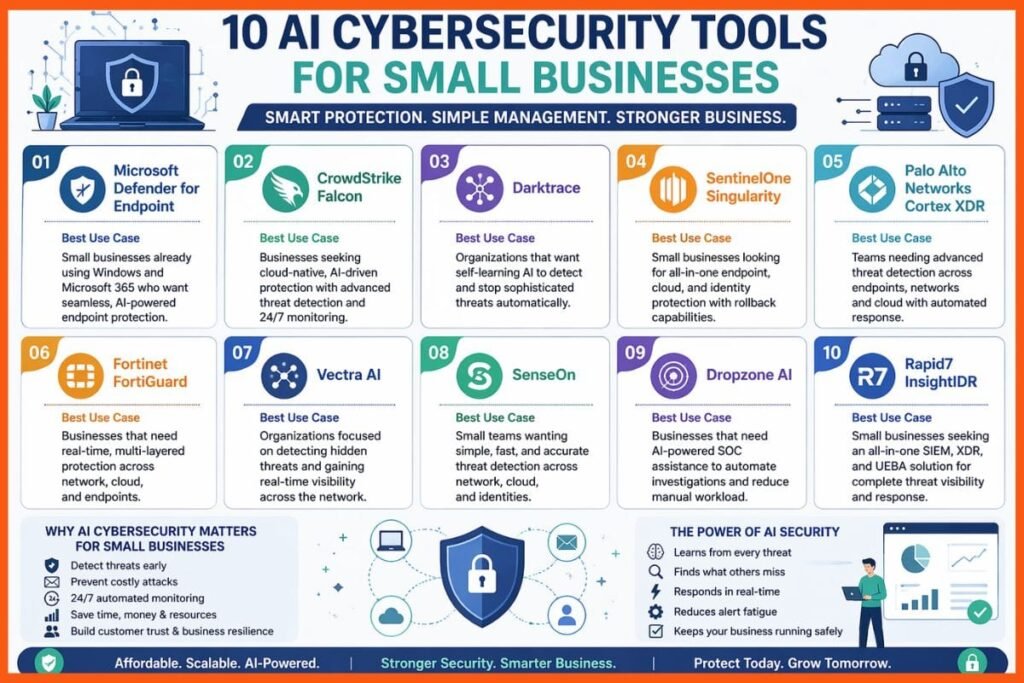
AI tools create a new layer of risk. Employees may use AI for drafting, research, customer support, coding, or analysis. The business should decide which information may be entered into those tools and which information must stay inside approved systems.
Security providers can help monitor identity and endpoint risks, but policy decisions still belong to the business. An AI security tool cannot replace a clear rule about confidential information.
Build a simple security scorecard
Review five areas every quarter: identity protection, backup and recovery, software updates, human behavior, and third-party access. Give each area a simple status such as needs work, acceptable, or strong. This keeps the discussion focused on business risk rather than technical jargon.
If identity protection is weak, fix MFA and privileged accounts before buying advanced monitoring. If backups are unreliable, improve recovery before spending on new detection software. Prioritize the control that reduces the most serious risk.
Final takeaway
The best cybersecurity service for a small business is not the one with the longest feature list. It is the service that closes important gaps, has clear responsibilities, and helps the owner recover when something goes wrong.
Keep simple controls in-house when they are easy to manage. Outsource specialist work when the business lacks the time or expertise to perform it well. Review the arrangement regularly as the company grows, adds employees, adopts AI, or changes its technology stack.
Sources: National Institute of Standards and Technology (NIST), Small Business Cybersecurity guidance and Cybersecurity Framework 2.0 Small Business Quick-Start Guide.


Pingback: Email Deliverability in 2026: Small Business Guide to the Inbox