
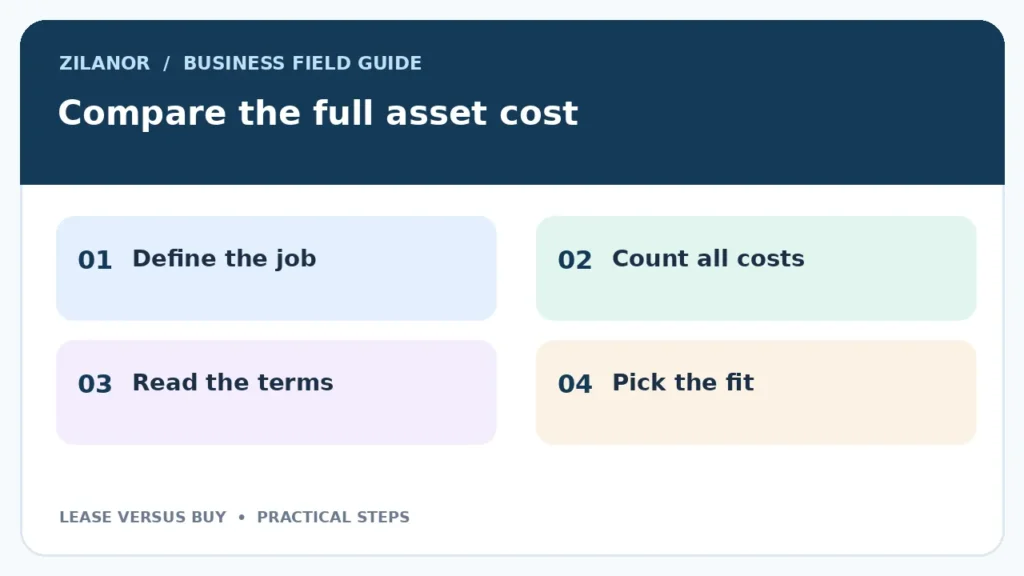

Equipment Lease vs Buy: Compare the Full Cost for a Small Business
A small firm needs a new machine, van or printer. A seller offers a monthly lease and a cash price. The smaller monthly amount may look easy, but it does not tell the full story. A lease can include fees, use limits and end terms. A purchase can tie up cash and leave the owner with repair costs. The right choice depends on how the firm will use the asset.
This guide gives a plain way to compare the options. It is for firms in many markets. Tax, legal and accounting rules differ by place, so ask a qualified local adviser before signing. The examples below are simple planning cases, not product offers.
Start with the job, not the payment
Define what the asset must do
Write down the work the item must handle, how often it will run and the years you expect to need it. A delivery firm may need a van every day. A design studio may need a large printer only a few times a month. The same kind of asset can lead to a different choice.
Think about the cost of downtime. If the item fails, can the team rent another one or move the work to a partner? Is a backup included in the service plan? A lower price may not help when a repair takes a week and the firm cannot serve buyers.
A small food maker needs a packing unit. The owner first lists pack size, daily output, power needs and cleaning time. Only then do they compare a new purchase, a used unit and a lease. This keeps the decision tied to work, not a sales pitch.

Put every cost on one timeline
Use the same period for each option
Choose a time span that fits how long the firm will use the item. For a short test, three years may be useful. For a core machine, a longer period may be needed. Compare the same years for each option. A two-year lease and a five-year purchase cannot be fairly compared by total cash alone.
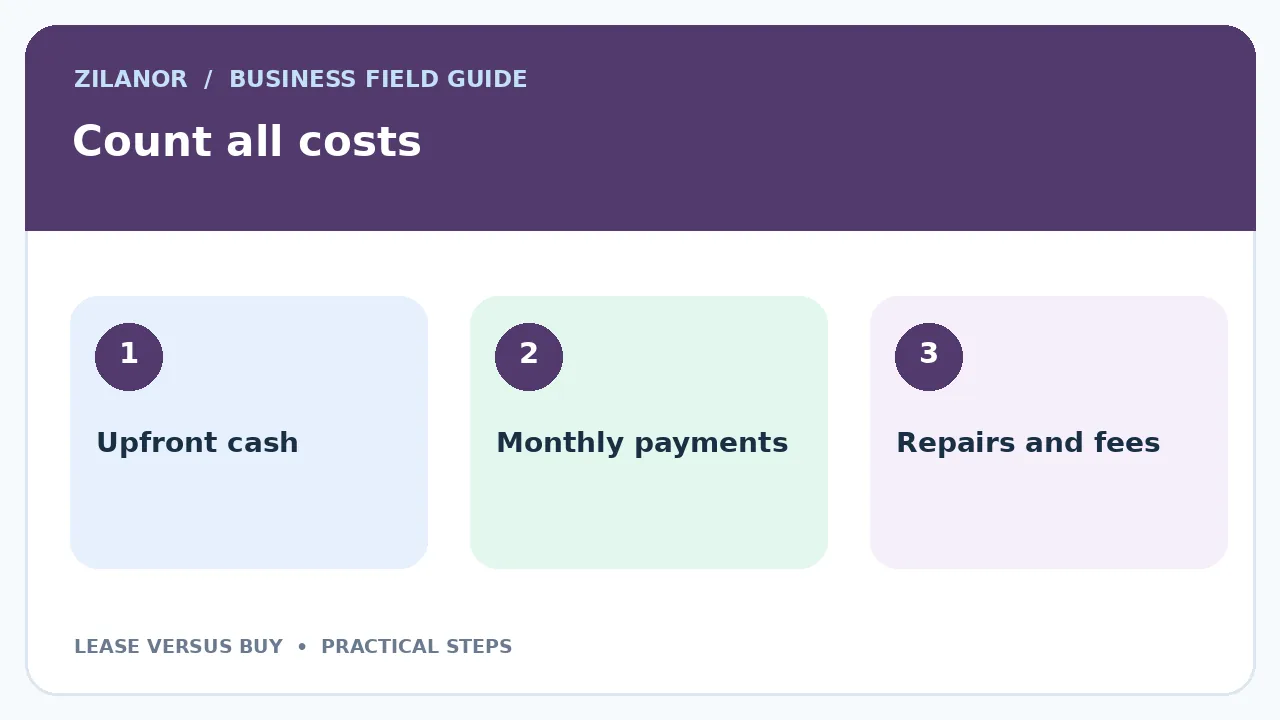
For a purchase, include price, delivery, setup, finance cost if any, repairs, service, parts and likely resale value. For a lease, include deposit, each payment, setup, service not covered, extra-use fees and the end charge. Do not leave a cost out just because it is paid later.
Keep the estimate honest. If resale value is unknown, show a range. If repairs may vary, use a low and high case. A single neat total can hide a large guess. A range gives the owner a better sense of risk.
Read the lease terms with care
Know who owns what at the end
Some deals are a rental. Others are a form of finance. The name in the sales pitch may not tell the legal or accounting result. Ask who owns the asset during the deal, what happens at the end and whether the firm can buy it. Get the answer in the signed terms.
Check rules on early exit, damage, use hours, distance, repairs and return condition. A van lease may have a distance limit. A printer plan may charge for extra pages. A machine lease may make the user pay for a major repair. A low monthly fee can turn costly when the asset is used more than planned.
Ask how the lessor handles a breakdown. Is there a service response time? Who pays for transport? Does a replacement arrive? If the business depends on the asset each day, these terms have real value.
Test a simple cash example
Do the math before tax effects
Imagine a tool that costs 12,000 in the local currency to buy. The owner expects to use it for three years and may sell it for 3,000 then. The net cash outlay before repairs and other costs is 9,000. Now imagine a lease of 300 per month for thirty-six months, with no deposit. The payments total 10,800.
That does not prove buying is better. The lease may include service or a replacement. The purchase may need repairs, storage or insurance. The firm may also need cash for stock. Add those items to the table before making a choice.
Compare the same cash dates, not just totals. If the business has limited cash now, paying 12,000 at once may create risk even when buying seems cheaper over three years. Ask what cash buffer remains after the purchase.
Look at use and change risk
Will the asset still fit next year?
Some tools lose value fast because a new model improves the work. Other machines can serve for ten years with basic care. If the need is not yet proven, a short rental may be a low-risk test. If demand is stable and the item is easy to maintain, buying may make more sense.
Write down the changes that could make the asset less useful. A shop may move. A supplier may change pack size. A new rule may affect the equipment. These are possible risks, not certain events. A good choice keeps options open where the future is hard to predict.
Do not pay a high price for flexibility you will never use. But do not lock the firm into a long term just to save a little each month. Match the contract to the real planning horizon.

Account for service and repair time
Ask what a failure costs the team
A machine’s cost includes the hours it stops work. If a printer fails on a key delivery day, staff may need to outsource the job. That cost may be more than the repair bill. Make a simple downtime plan for each option.
Ask the seller for service coverage in writing. Note response hours, parts, labour, travel and what is excluded. If the asset is used in a remote area, check whether help can reach the site. A service promise made for a large city may not fit every place.
For a used purchase, ask a skilled person to inspect it. Check service records, spare parts and the cost to move it. A cheap used item can be a good buy, but only if the firm understands its state and risk.
Ask the finance team about reporting
Do not treat every lease as rent in the books
Accounting rules may require a lease to be shown in a way that is different from a simple monthly rent expense. This depends on the framework the firm uses. The IFRS Foundation provides standards and updates. A local adviser should confirm which rules apply to this entity and this deal.
Tax treatment also varies. Do not assume that every lease payment is fully deductible or that a purchase gets one fixed tax benefit. Ask the accountant for an after-tax view when the amount is material. Keep the pre-tax cash view as well so the owner can see the real payment dates.
Save the signed deal, payment plan, service terms and any end option in one file. This helps the bookkeeper record the asset and makes later renewals easier to review.

Compare at least three quotes
Make each provider answer the same questions
Ask for a cash purchase quote, a lease quote and a short rental or used option where practical. Give each seller the same needs list. Request all fees in writing. Put the terms in one table, with a clear note if one option has a feature the others lack.
Do not compare a basic machine with a premium model without a reason. A higher output level or faster service may be useful, but the team should show how it changes the work. If it will not be used, it is not a fair benefit.
Check the provider’s support and the route for a complaint. A cheap deal with slow help may cost more later. Ask real users about service where you can and note that their experience is not a guarantee for your own case.
Plan the exit before the start
Know the cost to stop using the item
For a lease, note the last date to give notice, the return state and any early exit fee. For a purchase, think about resale, storage and safe disposal. The best decision includes the last day of use, not only the first month.
A small firm may grow and need a larger machine. Check whether the lease allows an upgrade and what it costs. A purchased item may be sold, but the resale value can fall. Use a cautious estimate and keep the risk in the plan.
Assign one person to track the renewal date. Set a reminder well before it. A missed notice can turn a flexible deal into an unwanted extra term.
Make the final choice clear to others
Write a one-page decision note. State the job, options, total cost range, cash need, service risk and exit terms. Record the choice and who approved it. If the cheaper option was not selected, explain the reason in plain words.
Revisit the choice after six months of use. Check the real running cost, downtime and output. This can improve the next equipment decision. The goal is not to prove the first estimate was perfect. It is to learn from actual use.
Final takeaway
A lease and a purchase are ways to get the same work done, but they move cash and risk in different ways. Start with the job. Compare all costs on the same timeline. Read service and exit terms, then check the cash buffer. A good choice is the one your firm can use, maintain and leave with a clear plan.


